Governments around the world are under growing pressure to deliver public-facing services more efficiently, and to meet the expectations of applicants who are used to fast, convenient, personalised experiences in other areas of their lives. In visa processing, consular services, residence permit renewals, and other high-volume administrative processes, governments are increasingly looking to introduce more flexible service delivery models, with the support of specialist external service providers. These external partners bring operational expertise, infrastructure, and scalability to support government departments with their front-end service delivery.
But what does flexible service delivery actually look like in practice? And what are the processes and safeguards required to ensure consistent, compliant service levels in all circumstances?
Scaling capacity up and down: managing demand across the year
One of the key advantages for governments of working with an external partner for public-facing service delivery is the ability to adjust capacity in response to changing demand. Application volumes can increase due to seasonal travel patterns, new visa categories, or a sudden surge from a particular country, for example. Specialist service providers are built to respond to exactly this kind of fluctuation. They can increase staffing at busy periods, extend opening hours in the evenings or at weekends, and make better use of their facilities to handle higher volumes without a drop in service quality. When demand falls, they can scale back with the same efficiency.
At TLScontact, we continuously monitor volumes and use enhanced capacity planning tools to anticipate future trends, allowing us to adjust our processing capacity accordingly. That can mean hiring new staff or extending opening hours. Where volume shifts are more permanent, we can relocate centres to larger premises, as we recently did for the delivery of UK Visa & Citizenship Application Services in Croydon, south London.
Temporary and pop-up service locations: taking services closer to applicants
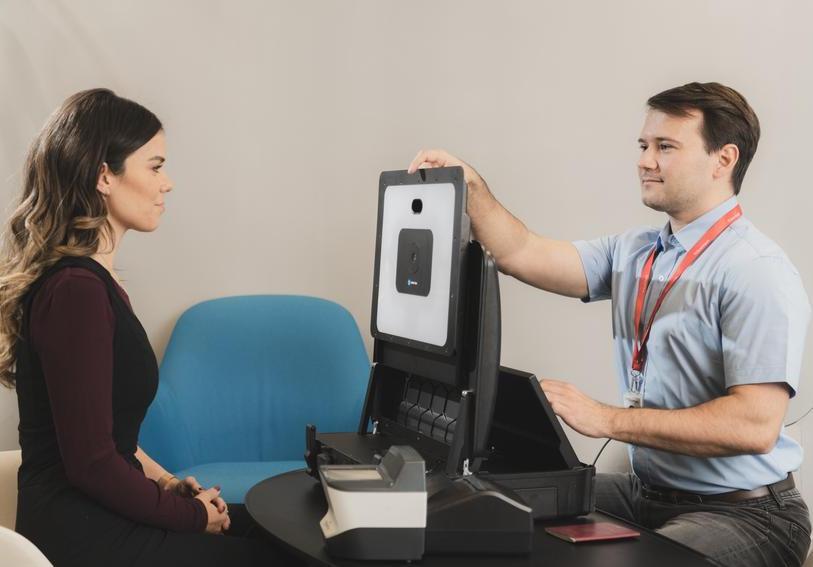
Beyond their permanent facilities, service providers can also deploy additional, temporary locations when and where they are needed. In a consular emergency – when large numbers of people suddenly need urgent document processing – a provider can set up a temporary facility at short notice to manage the situation.
One such example was the emergency visa application centre that TLScontact set up for the UK in Rzeszow, eastern Poland, following the start of the Ukraine war, to manage the sudden spike in visa applications from Ukrainian refugees.
Temporary locations also serve more routine needs, enabling applicants in cities far from the capital to access services locally, a few days each month, rather than making long and costly journeys to a central office. This extends the geographic reach of a government’s service network significantly.
For example, the TLScontact service to the French government for visa applicants in Cameroon includes two permanent visa application centres in Douala and Yaoundé, but we also operate a small satellite centre in Garoua, open two days a month, serving applicants in the north of the country.
Flexible service delivery: benefits and safeguards
Flexible service delivery models offer real benefits to both governments and service users. However, operating outside traditional, permanent facilities requires careful preparation, and the right safeguards.
At TLScontact, any temporary services are always designed and deployed in close coordination with our government clients. This ensures that new service points genuinely reflect market needs: the right locations, the right capacity, at the right time.
Equally important is oversight. The same group standards that apply in our permanent application centres must be enforced consistently in temporary locations. That means security protocols, data privacy standards, and overall service quality are subject to exactly the same scrutiny, wherever the service is being delivered. We put in place strict internal controls to ensure rigorous application of our standard operating procedures. They are complemented by external oversight mechanisms such as client audits and “mystery shopper” missions.
This is not simply a question of security and compliance: it is about ensuring that the same high standards of customer care are applied consistently across our global network, from our permanent centres – whatever the level of demand for our services – to temporary locations. We combine internal and external controls with regular analysis of customer feedback, to confirm that we are providing the best possible customer experience and identify any potential issues. This allows governments to extend services with confidence, and gives applicants the assurance that they will receive the same quality of care regardless of where or how they access our services.
Done in the right way – with careful design, close coordination, and strong oversight – flexible service delivery can bring genuine value to governments and users alike. It is also something that specialist external service providers like TLScontact are uniquely positioned to offer. For any government looking to improve the delivery of visa, consular, or administrative services, flexible service delivery models provided by external partners offer a clear and proven path forward.
Article written by
Arnaud Lefebvre, Chief Operating Officer